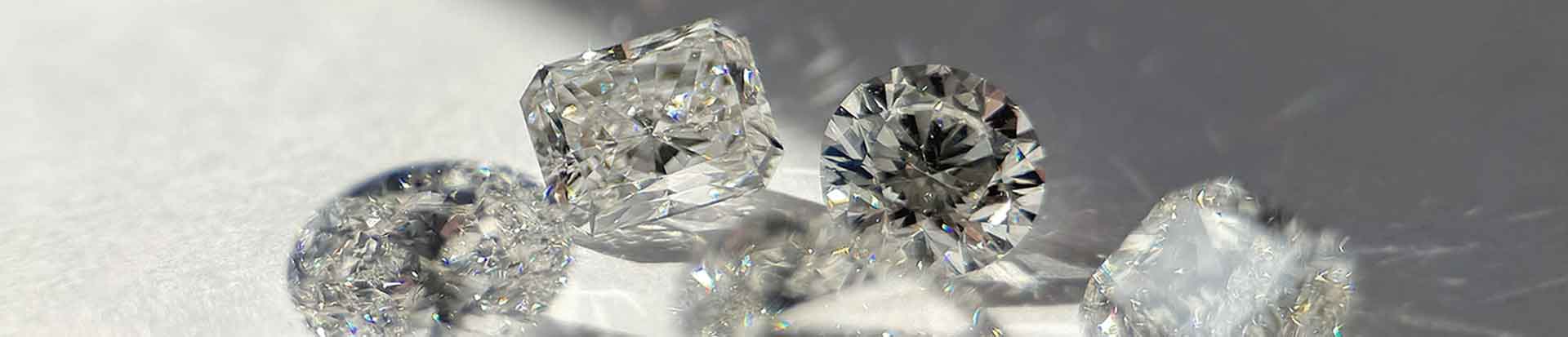
Synthetic Lab Grown Diamonds
Lab grown diamonds - current pricing
Price guide as of June 2026
| Round Brilliant Cut | |||||
|
Carat |
Colour |
Clarity |
Cut Grade |
Certified |
Price |
|
1.00 |
D/E |
VVS |
XXX |
IGI Certified |
$420 |
|
1.50 |
D/E |
VVS |
XXX |
IGI Certified |
$675 |
|
2.00 |
D/E |
VVS |
XXX |
IGI Certified |
$870 |
|
2.50 |
D/E |
VVS |
XXX |
IGI Certified |
$1040 |
|
3.00 |
D/E |
VVS |
XXX |
IGI Certified |
$1930 |
| Oval Cut | |||||
|
Carat |
Colour |
Clarity |
Cut Grade |
Certified |
Price |
|
1.00 |
D/E |
VVS |
XX |
IGI Certified |
$420 |
|
1.50 |
D/E |
VVS |
XX |
IGI Certified |
$675 |
|
2.00 |
D/E |
VVS |
XX |
IGI Certified |
$870 |
|
2.50 |
D/E |
VVS |
XX |
IGI Certified |
$1040 |
|
3.00 |
D/E |
VVS |
XX |
IGI Certified |
$1930 |
| Emerald Cut | |||||
|
Carat |
Colour |
Clarity |
Cut Grade |
Certified |
Price |
|
1.00 |
D/E |
VVS |
XX |
IGI Certified |
$420 |
|
1.50 |
D/E |
VVS |
XX |
IGI Certified |
$675 |
|
2.00 |
D/E |
VVS |
XX |
IGI Certified |
$870 |
|
2.50 |
D/E |
VVS |
XX |
IGI Certified |
$1040 |
|
3.00 |
D/E |
VVS |
XX |
IGI Certified |
$1930 |
| Radiant Cut | |||||
|
Carat |
Colour |
Clarity |
Cut Grade |
Certified |
Price |
|
1.00 |
D/E |
VVS |
XX |
IGI Certified |
$420 |
|
1.50 |
D/E |
VVS |
XX |
IGI Certified |
$675 |
|
2.00 |
D/E |
VVS |
XX |
IGI Certified |
$870 |
|
2.50 |
D/E |
VVS |
XX |
IGI Certified |
$1040 |
|
3.00 |
D/E |
VVS |
XX |
IGI Certified |
$1930 |
| Princess Cut | |||||
|
Carat |
Colour |
Clarity |
Cut Grade |
Certified |
Price |
|
1.00 |
D/E |
VVS |
XX |
IGI Certified |
$420 |
|
1.50 |
D/E |
VVS |
XX |
IGI Certified |
$675 |
|
2.00 |
D/E |
VVS |
XX |
IGI Certified |
$870 |
|
2.50 |
D/E |
VVS |
XX |
IGI Certified |
$1040 |
|
3.00 |
D/E |
VVS |
XX |
IGI Certified |
$1930 |
Prices are indicative and vary based on diamond cut, colour, clarity, certification, and market conditions.
Choosing the right diamond
Selecting the right diamond is a deeply personal decision:
- Prioritise cut quality for brilliance
- Compare certified stones for confidence
- Choose designs aligned with your lifestyle
- Work with a trusted jeweller
At Solid Gold Diamonds, while we are able to source high-quality lab-grown diamonds on request, our heritage is firmly rooted in the selection of exceptional natural diamonds of enduring significance.
Given the evolving nature of the lab-grown diamond market—particularly ongoing price adjustments—we take a considered approach by sourcing each stone to order. This ensures our clients receive exceptional value for money, alongside optimal quality and complete transparency, rather than relying on pre-held inventory.


Rough diamonds from various origins: laboratory-grown CVD rough diamond (left), laboratory-grown HPHT rough diamond (middle), natural rough diamond (right).
Courtesy of GIA
Pros and cons
Why choose lab-grown diamonds?
Lab-grown diamonds offer a contemporary alternative for those seeking flexibility:
Accessible Luxury – Typically 30–50% more affordable than natural diamonds
Design Flexibility – Allows for larger or higher-grade stones within budget
Comparable Appearance – Similar brilliance and visual appeal
Transparent Origins – Produced in controlled environments, with clearly traceable creation
At Solid Gold Diamonds, every diamond we offer—natural or lab-grown—is selected with a commitment to transparency, integrity, and expert craftsmanship. Our natural diamonds adhere to the Kimberley Process, ensuring they are responsibly sourced and conflict-free.
However, for those drawn to rarity, provenance, and enduring legacy, natural diamonds continue to represent the pinnacle of fine jewellery.


(Courtesy of GIA via Suncrest Diamonds)
The Process
How are lab-grown diamonds made?
Lab-grown diamonds are created using two advanced methods:
HPHT (High Pressure High Temperature)
Replicates the high-pressure conditions found within the earth
CVD (Chemical Vapour Deposition)
Grows diamonds layer by layer from carbon-rich gases
While technologically advanced, these processes contrast with the extraordinary natural journey of mined diamonds, formed under unique geological conditions over billions of years.
Grading
The 4Cs of lab-grown diamonds
Like natural diamonds, lab-grown diamonds are evaluated using the Four Cs:
Cut – Determines brilliance, fire, and light performance
Colour – Graded from D (colourless) to Z. GIA do not provide a traditional colour grading instead dividing into 2 categories, Premium or Standard.
Clarity – Measures internal and surface characteristics
Carat Weight – Refers to the diamond’s weight
Although grading standards are identical, rarity remains a defining factor that distinguishes natural diamonds as true luxury assets.


(Courtesy of GIA)


(Courtesy of GIA)
Know what you're buying
Certification & authenticity
All lab-grown diamonds should be certified by reputable laboratories, such as:
IGI (International Gemological Institute)
GIA (Gemological Institute of America)
At Solid Gold Diamonds, all lab-grown diamonds are IGI certified, ensuring confidence in quality and grading accuracy.
Buy with confidence
A reputable certified lab-grown diamond provides assurance of quality and authenticity.
At Solid Gold Diamonds, we are committed to guiding each client toward the diamond that best reflects their values—whether that be modern innovation or the enduring rarity of natural diamonds, which remain the ultimate expression of luxury.
The Four C's
Diamond Carat Weight
Carat refers to a diamond’s weight, not its size. As larger diamonds are rarer, price rises exponentially with carat weight.
The word ‘carat’ is taken from the carob seeds that were used to balance scales in ancient times, but it is not to be confused with the word ‘karat’, which is the method for determining the purity of gold.
However, carat alone does not define beauty. A well‑cut diamond of smaller carat weight can appear larger and more brilliant than a heavier, poorly cut stone.


(Courtesy of GIA)
Are lab-grown diamonds sustainable?
While lab-grown diamonds are often promoted as a “sustainable” choice, their environmental impact is more complex. Their production is highly energy-intensive, and overall sustainability depends heavily on the energy sources used.
High Energy Consumption – Both HPHT and CVD processes require substantial electricity
Variable Carbon Footprint – Use of fossil fuel energy can significantly reduce environmental benefits
Inconsistent Industry Standards – Sustainability claims vary, with limited global regulation
By contrast, natural diamonds are created by the earth itself over billions of years, requiring no industrial energy input during their formation. Today, the natural diamond industry operates under strict environmental regulations, including land rehabilitation, biodiversity protection, and responsible sourcing initiatives.
As a result, when considering the full lifecycle and long-term environmental stewardship, natural diamonds are increasingly recognised as the more sustainable and responsible choice.
This distinction highlights the importance of transparency and informed decision-making when evaluating sustainability in modern diamond sourcing.
Lab-grown vs natural diamonds
|
Feature |
Lab-grown diamonds |
Natural diamonds |
|
Origin |
Created in weeks |
Formed over billions of years |
|
Price |
More accesssible |
Reflects rarity and legacy |
|
Appearance |
Comparable |
Unique and naturally occurring |
|
Rarity |
Readily produced |
Exceptionally rare |
|
Long-term value |
Limited resale |
Historically enduring |
|
Ecological impact |
Energy-intensive production |
Regulated mining with land rehabilitation |
Investment considerations
Lab-grown diamonds offer immediate visual appeal and accessibility, however they typically do not retain long-term value in the same way as natural diamonds.
Natural diamonds, particularly those of exceptional quality or rarity, continue to be regarded as timeless assets and heirlooms, valued across generations.

